ACL Tears
Specialized care for ACL injuries in athletes and active individuals. Treatment is focused on restoring knee stability, protecting the meniscus and cartilage, and helping patients safely return to sports and the activities they love.
Understanding ACL Tears
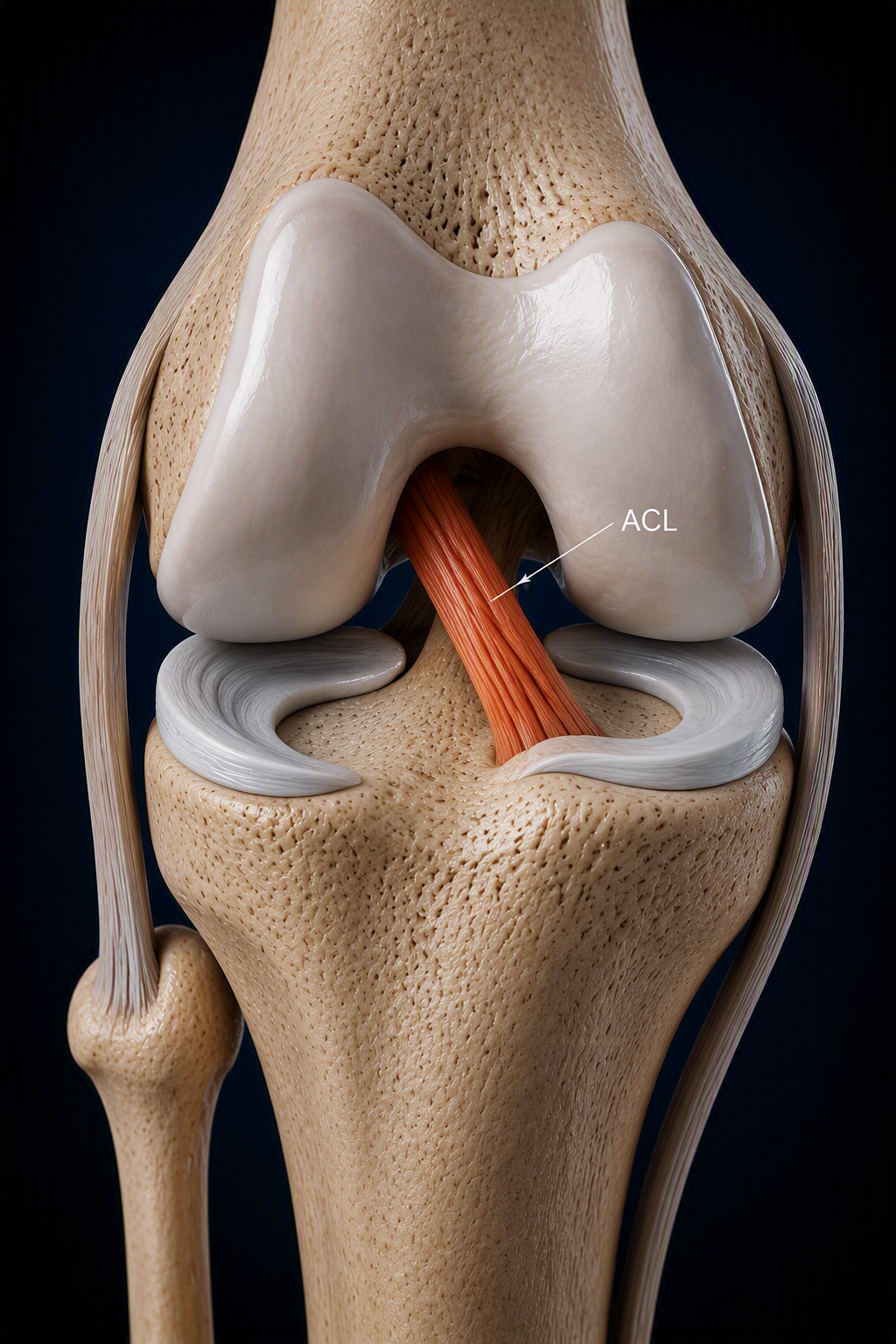
The knee is one of the largest and most complex joints in the body. It is formed by three bones: the femur (thigh bone), tibia (shin bone), and patella (kneecap). Together, these structures allow the knee to bend, straighten, and absorb the forces generated during walking, running, jumping, and sports.
Several important ligaments stabilize the knee. One of the most important is the anterior cruciate ligament (ACL), which runs through the center of the knee and helps prevent the tibia from sliding forward while also providing rotational stability.
The knee also contains two shock absorbers called the menisci, which help distribute load and protect the articular cartilage. Meniscus injuries frequently occur alongside ACL tears.
Anatomy of the Knee
Understanding ACL Tears
What is an ACL Tear?
An ACL tear occurs when the anterior cruciate ligament is stretched or torn, often during athletic activities involving pivoting, cutting, jumping, or sudden changes in direction.
ACL tears commonly occur during:
Basketball
Football
Soccer
Lacrosse
Skiing
Volleyball
Gymnastics
Many athletes report hearing or feeling a "pop" at the time of injury.
Common Symptoms of an ACL Tears
Patients commonly experience:
A popping sensation at the time of injury
Immediate swelling
Knee instability or "giving way"
Difficulty pivoting or cutting
Loss of confidence during sports
Pain and limited activity
Reduced athletic performance
Associated Injuries
ACL tears frequently occur with other injuries, including:
Meniscus Tears
The meniscus acts as a shock absorber within the knee. Meniscus tears are commonly seen with ACL injuries and may require repair or treatment at the time of surgery.
Cartilage Injuries
Damage to the articular cartilage can occur during the initial injury and may increase the risk of future arthritis.
MCL Injuries
Some ACL injuries occur alongside injuries to the medial collateral ligament (MCL), particularly after contact sports injuries.
Treatment Options
Non-Surgical Treatment
Not all ACL tears require surgery.
Some individuals who do not participate in pivoting sports may be able to return to an active lifestyle with:
Physical therapy
Strengthening programs
Activity modification
Functional bracing
Neuromuscular training
Many patients can successfully manage their symptoms without surgery.
When Is Surgery Recommended?
ACL reconstruction may be recommended for patients who:
Wish to return to cutting or pivoting sports
Experience recurrent instability
Have associated meniscus injuries
Have physically demanding occupations
Want to protect the long-term health of the knee
The goal of surgery is to restore stability and allow a safe return to activity while protecting the meniscus and cartilage from future injury.
ACL Reconstruction Surgery
ACL reconstruction replaces the torn ligament with a graft that functions as a new ACL.
Common Graft Options
Bone-Patellar Tendon-Bone (BTB) Autograft
A strong and reliable option with a long track record of success, particularly in competitive athletes.
Quadriceps Tendon Autograft
An increasingly popular option that provides excellent strength and stability with less kneeling discomfort for many patients.
Hamstring Tendon Autograft
A reliable option that utilizes the patient's own hamstring tendons for reconstruction.
Allograft
Donor tissue that eliminates graft harvesting but is typically reserved for select patients and lower-demand individuals.
IT Band Autograft
This graft is harvested from the IT band along the side of the leg and routed into the knee joint to act as the new ACL. It is reserved for patients who have open growth plates and 3+ years of growth remaining where there is not enough space to drill large sockets for the other common ACL graft options.
Additional Stabilization Procedures
In some athletes, additional procedures such as:
Lateral Extra-Articular Tenodesis (LET)
Anterolateral Ligament (ALL) Reconstruction
may be recommended to improve rotational stability and reduce the risk of re-injury.
Frequently Asked Questions
-
You can take the brace off for showering, dressing, and to do your exercises with physical therapy. You can also remove the brace while icing. However, you must wear the brace at all other times, including sleeping and when walking.
-
For your right knee, you may not resume driving until 4 weeks post-op, when your brace is removed. For your left knee, you may resume driving when you are no longer taking narcotic pain medicine and when you feel you have control of your leg.
-
You may not fly for 2 weeks after your surgery. This is to prevent post-operative complications such as DVT (blood clot). When you do fly, it is important that you take aspirin before your flight and perform ankle pumps frequently. You should also get up and move around the plane as frequently as possible.
-
We will need to see you for a follow-up appointment around 10-14 days after your surgery. Dr. Danaher will then assess your recovery to determine the timing of additional appointments. Most commonly you will be seen at 2 weeks, 6 weeks, 3 months, 6 months, 9 months and one year after surgery. The timing of further visits will be determined by Dr. Danaher.
-
This is variable, of course, but we provide you with an appropriate amount of narcotic pills to keep you comfortable until your 1st post-operative visit. You should take these pills as needed. You can take 1-2 pills every 4-6 hours. You can also take 600mg of Advil, Aleve, Motrin, or ibuprofen in conjunction with your pain medication.
-
Most patients receive a regional block unless there is a contraindication to it. Further anesthesia is determined by your anesthesiologist. Your anesthesiologist will speak with you before the procedure and address any of your questions or concerns
-
This really depends on the individual patient specifically with respect to job demands (labor vs desk job). Desk jobs may return to work within days and labor jobs typically around 3 months.
-
You may not return to contact sports for 6-9 months. However, you will be able to participate in certain activities in a progressive manner throughout your recovery. These activities depend on your progress and timeframe of recovery and will be determined by your therapist and/or doctor.
-
The typical therapy program will be a minimum of 6 months. The 1st phase of therapy will be designed to safely regain your range of motion while the 2nd phase of therapy will be directed at regaining function, strength, and endurance.
-
When you do not have any pain, inflammation, or swelling, you may discontinue cryotherapy. If you experience any discomfort or inflammation after exercising or returning to activity, resume your cryotherapy immediately. Even when you do not have immediate symptoms, you may utilize cryotherapy preventively to avoid any residual symptoms. Use for 3-7 days, 3-5 times per day for 30 minutes to 1 hour each session.
-
You should plan to wear loose, comfortable clothing and supportive, stable shoes. Slip on shoes are easier to get into after surgery.
-
Yes. But other valuables (Laptops, iPads, iPods, Jewelry, etc) should be left at home.
-
Do not assume it will heal on its own. Please call Dr. Danaher's office right away to determine if you need an evaluation.
-
Any signs of infection should be reported immediately – these include increased drainage (usually thick, cloudy, not liquid secondary to the arthroscopy), redness, increased warmth, and fevers (T > 101.8).